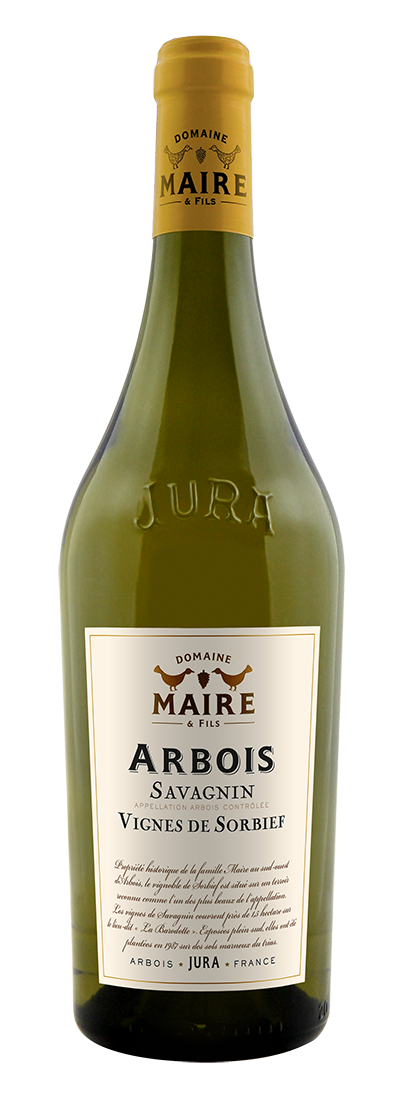
ARBOIS SAVAGNIN VIGNES DE SORBIEF 2020

- A surprising nose revealing both fruit and mineral notes.
- In the mouth, the Savagnin expresses itself wonderfully on this unique terroir combined with the ageing in oak barrels, offering a powerful wine with nice substance, mineral notes of lemon, white flowers aromas and a very pleasant finish.
The Arbois AOC is the oldest and largest of the Jura's four geographic AOCs. In particular, it was France's first AOC (created in 1937).
Its name originates in the Celtic words "ar" and "bois" that would mean "fertile land".
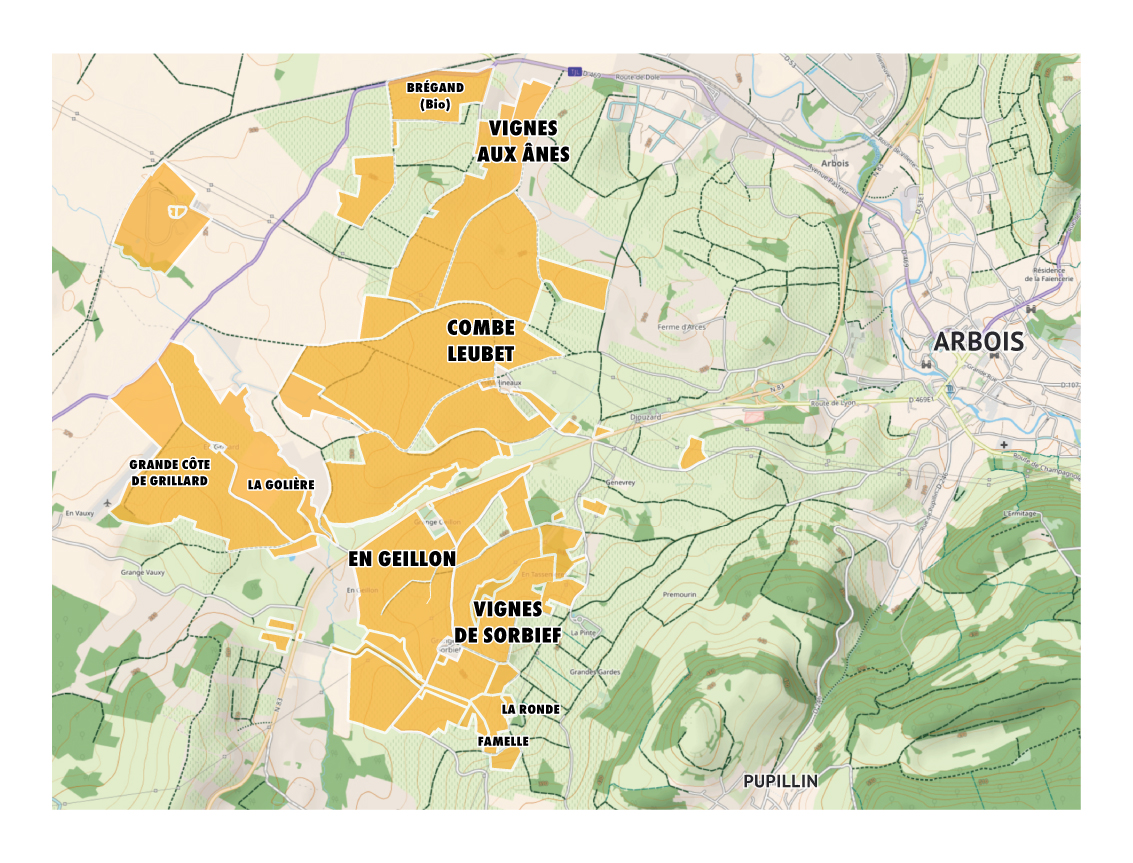
Particularly adapted to this late and demanding grape variety, the plot called “La Barodotte” is located in the west of the Domaine and to the southwest of the Arbois village on a lovely hill overlooking the famous “Route des vins du Jura” (the Jura wine road) RN 83:
- Surface: 1,5 Ha.
- Full South exposure.
- Average age of vines : 38 years (1987).
- Triassic marls sols.
The work in the vines, is based on the respect of the nature and the soil. We practice soil reassembly to aerate the lands subjected to settlement due to moisture, and grass with plants. Such as clover, which, by competing on the vine, can modulate its mineral and water supply and control its vigour and yield.
The Guyot double size is necessary to better control the vine performance.
Reception of the grapes, harvested manually, sorting and vatting by gravity into a thermo-regulated tank for the fermentation.
Once the grapes are pressed, the musts are settling under control temperature.
Then the wine is placed into oak barrels (with 30% of new oak) for the fermentation and a 9 months ageing period on fine lees, to expand its aromatic palette.
It is a "naturé" Savagnin, a term used when aging wines while protecting them from contact with air, by filling them up as the level drops due to natural evaporation.
Bottling in June with a light filtration.
he current public health crisis has certainly marked this year’s harvest, which nonetheless has been able to go ahead!
We were slightly less affected in the Jura vineyards, by drought than other regions thanks to rain during the month of August. One of the main challenges with this very early harvest was to achieve both optimal ripeness and balance.
Harvest was spread over a month on this estate, which has 234 ha (578.22 ac) in production this year. The harvest was good thanks to the replanting and reorganizing carried out in the vineyard over the last five years.
Initial tastings, Jacques Hauller:
‘The Jura, now more than ever, can lay claim to being the sixth sub-region of Burgundy! It boasts citrusy Chardonnays with a distinct mineral quality despite the very ripe state of the grapes and fruity Pinot Noirs with ripe tannins.
Careful plot selection reveals the potential of our Vignes aux Anes Trousseau; Vignes de Sorbief Savagnin and Chardonnay; a new gem like the delicate, elegant Pinot Noir in Arbois-Pupillin in the locality called ‘La Ronde’, which has been planted alongside the largely-forgotten native variety, Petit Béclan, which produces lively, light red wines which are great for blending purposes; and last but not least, carefully-selected Chardonnay from the vines at Grange Grillard.’