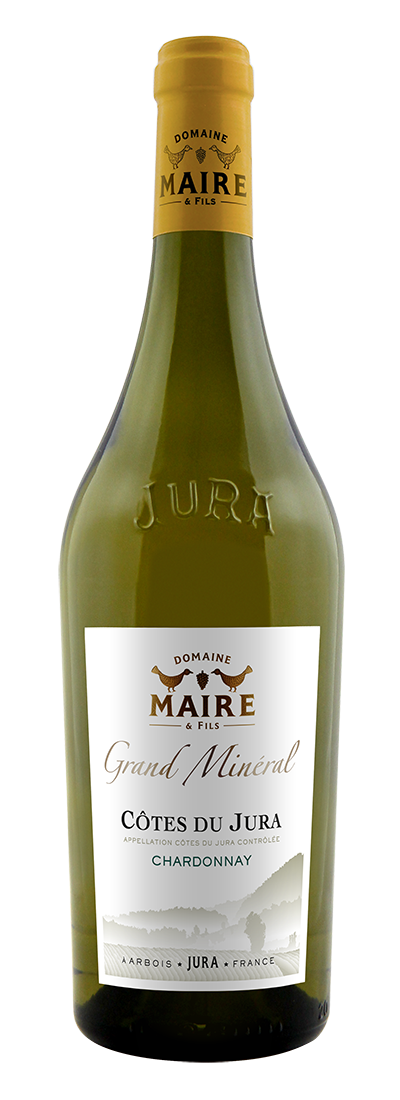
The Chardonnay grape variety, originating from Burgundy but cultivated in the Jura since the 10th Century, has become a native of the region. Its great adaptability makes it the most prominent grape variety today, especially on limestone and light soils.
CÔTES DU JURA CHARDONNAY 2025

click on one of the vintages below for further information
Several generations have been necessary to patiently built one of the largest and greatest estates in the area, focused on key appellations such as Château-Chalon, l’Étoile and Arbois. The Domaine MAIRE & Fils covers nowadays around 240 hectares of vines producing all the area grapes varieties.
In order to develop a harmonious cuvée, our Côtes du Jura comes from a selection of our best plots. The Chardonnay grow on clay limestone soils.
The work in the vines, is based on the respect of the nature and the soil. For young vines, located on steep slopes, to avoid erosion, we cultivate a row out of two, practice soil reassembly to aerate the lands subjected to settlement due to moisture, and grass with plants. Such as clover, which, by competing on the vine, can modulate its mineral and water supply and control its vigor and yield. The Guyot double size is necessary for the Chardonnay to better control its performance. The restructuring of the vines contributes to the harmony of our cuvée: the young vines bring the exuberance, the freshness and the acidity. While the older specimens bring the structure and character.
Reception of the grapes, vatting by gravity into a thermo-regulated tank for the fermentation.
They are pressed, and musts are settling under control temperature.
Then the fermentation starts, maintained at low temperature (20- 22°C). Ageing in stainless steel tanks, on fine lees and for 2 -3 months to aid the preservation of the wine's minerality, purity of fruit and crisp acidity.
They are pressed, and musts are settling under control temperature.
Then the fermentation starts, maintained at low temperature (20- 22°C). Ageing in stainless steel tanks, on fine lees and for 2 -3 months to aid the preservation of the wine's minerality, purity of fruit and crisp acidity.
The 2025 vintage will be remembered as a year marked by earliness and quality in the Jura vineyard. The first grapes were harvested at the Domaine for Crémant as early as August 19. Still wines followed in early September, with a staggered harvest schedule running through September 15 depending on grape varieties and parcels.
Flowering proceeded smoothly overall, and the grape clusters showed excellent sanitary conditions. Chardonnay and Savagnin display outstanding potential, while red varieties such as Poulsard and Trousseau came through the early-summer heatwaves without difficulty. The vineyard experienced a few very localized hail events in July, but the overall harvest remains highly promising.
Thanks to its earliness, the vintage shows great promise, with well-balanced sugar levels and acidity. Managing harvest dates was a key challenge and made it possible to bring in the full diversity of Jura varieties at their optimal potential.
Harvesting concluded on September 15, and the 2025 vintage may well leave a lasting impression.
Flowering proceeded smoothly overall, and the grape clusters showed excellent sanitary conditions. Chardonnay and Savagnin display outstanding potential, while red varieties such as Poulsard and Trousseau came through the early-summer heatwaves without difficulty. The vineyard experienced a few very localized hail events in July, but the overall harvest remains highly promising.
Thanks to its earliness, the vintage shows great promise, with well-balanced sugar levels and acidity. Managing harvest dates was a key challenge and made it possible to bring in the full diversity of Jura varieties at their optimal potential.
Harvesting concluded on September 15, and the 2025 vintage may well leave a lasting impression.